Cloud AI vs local AI: what it really costs your company (and why the agent, not the chat, is the point)
“But ChatGPT already has an agent, Dot. Why would I pay more for ILAI?”
It’s the question we get more and more, and it’s the right question. It deserves an honest answer.

In the storm of a connected world, your data is scattered at sea. The lighthouse is the local box that guides it home — in-house, where it belongs.
The short answer: Dot is an agent, but it’s not an agent that does your company’s work. It’s a personal assistant that runs in a cloud, that works for you as a person, with your prompts, and that doesn’t live inside your ERP, your CRM, or your accounting. ILAI is something different: an agent built for that company’s processes, on a machine where the data stays. It’s not the same category, and price alone says nothing about the difference.
This is the point we want to explain properly, without shortcuts.
The mistake: treating a chat box and an agent as two prices for the same product
When someone says “I can get an agent for $25 a month,” they’re conflating two products.
A ChatGPT or Claude subscription buys you a model you can talk to. A text box, very powerful, that you ask questions and that gives you answers. Even when OpenAI adds an “always-on” agent like Dot, you’re still talking to a model that runs in their cloud, on their data plane, for your personal tasks. It’s a very capable personal assistant. It’s not a colleague with access to your invoicing system, that knows how you want things done, and that does them.
The agent, in the sense we mean it, is a software product that we build: it connects to the client’s systems, knows the company’s rules and tone, and executes the work — it doesn’t answer a question. The model is the engine; the agent is the vehicle, the work, and the destination.
The distinction that matters, in practice, is a single one: who moves the pieces.
| Chat box (subscription) | Agent (ILAI) | |
|---|---|---|
| Who does the work | You: ask, receive, copy-paste into your system | The agent: does the work inside your systems, on its own |
| Autonomy | Reactive: waits for your prompt | Works the day while you’re elsewhere |
| Integrates with ERP/CRM/documents | No: it’s a generic text box | Yes: it’s built for those systems |
| Knows your company’s rules | No | Yes: the “skill” encodes them |
| Where the data lives | Their cloud, outside the EU | On-site (on-prem) or in the EU (on-cloud) |
The chat box wins — and will always win — on the price of chat. It’s a subsidized product: you pay a flat fee and the provider covers the tokens at a loss, because they want you to stay inside their ecosystem. They’re not selling work, they’re selling a habit.
But if the comparison is “how much does the chat cost,” then you’re comparing the wrong thing. The real question is: who does the work.
What a chat box can’t do — even with an “always-on” agent
Dot is a real thing, and we don’t diminish it: it’s an agent that works autonomously, does research, executes steps. It’s an excellent personal assistant. But its radius of action is you, as a person: your prompts, your documents, your tasks. It’s not connected to your company’s workflow. It doesn’t know that invoices get done a certain way, that quotes have a certain tone, that client data has to stay inside.
ILAI does the opposite work. It takes a concrete process of the company — reconciling invoices, preparing a quote, updating the CRM, answering a category of requests — and executes it inside the systems, with the company’s rules, continuously. The difference is not one of degree (“the agent is smarter”); it’s one of category:
- Pull vs. push. The chat requires a human to move the pieces from one system to another. The agent moves them on its own, continuously.
- Generic vs. specific. The chat box is the same for everyone. The agent is built for that company: its skill encodes its processes.
- Their cloud vs. your machine. Dot runs on an OpenAI server. ILAI runs where your data stays yours.
This is the difference no price can buy you: a subscription is a service you rent, and it ends when you stop paying. An agent on your own machine is work you own, built for you.
The local box does things no cloud subscription can
This is where it gets concrete. The ILAI local box isn’t just “where the model runs”: it’s a capability you own, and it does things a cloud subscription can’t do, by construction.
- Voice — live today. A voice agent that runs on the client’s machine: dictation, voice replies, intercom. No per-hour API cost, no data leaving.
- OCR — live today. Processes a whole folder of invoices, photos, or scans on-site: no per-page API, no upload, no document leaving the building.
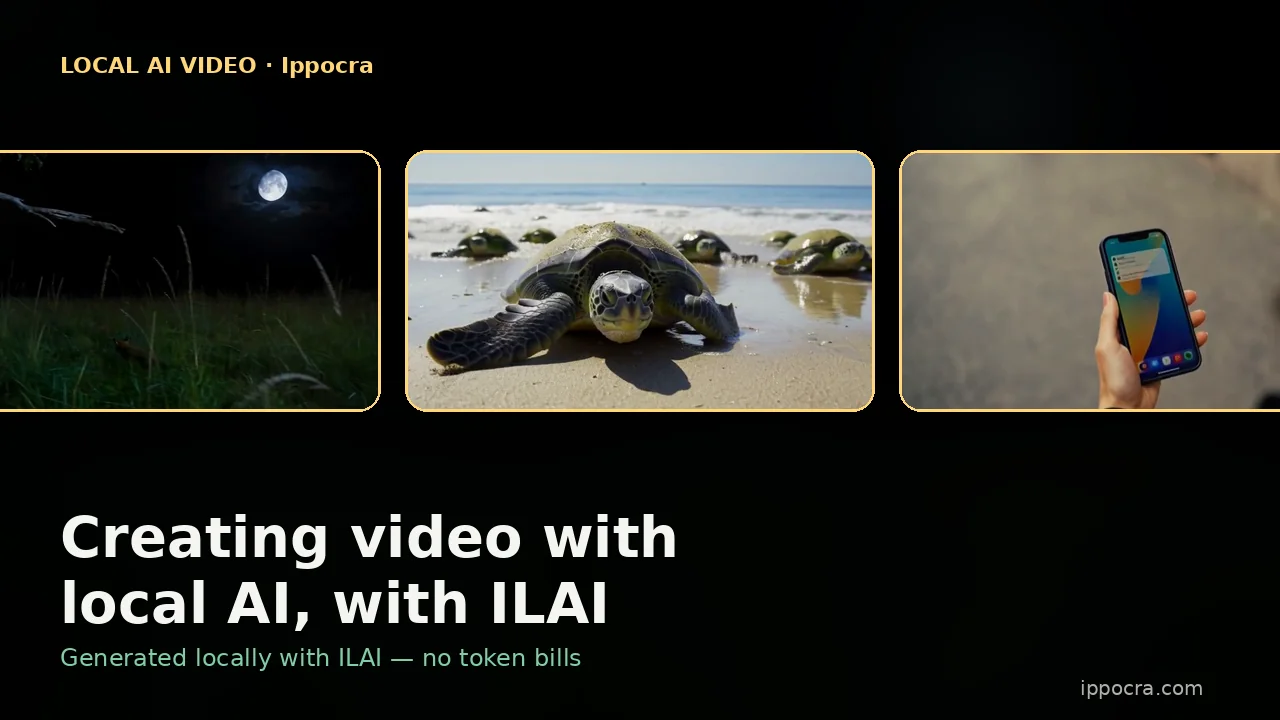
- Video generation — on request. If you need it, we set up video generation on the box as a specialized service. The material doesn’t leave the premises.
- The agent model — live today. The agent that does the work: invoices, quotes, CRM, email.
And there’s a reason that’s more than technical: the data stays the company’s. Invoices, client data, prices — processed on a machine in the client’s office, not on a server in the United States. This isn’t an optional, isn’t a “feature”: it’s the reason you buy the box, and it’s the one argument no cloud plan can match, at any price.
When the reader understands it — that they’re buying equipment that does voice, OCR, and video, plus the agent, with their own data at home — the price stops being “the chat is expensive” and becomes “the equipment is cheap.”
And the price?
Here we’re honest, because that’s how it is.
For chat alone, the subscription costs a lot less. ChatGPT Business or Claude Team are around $25 per user per month. Even the Dot agent starts at $100 a month per person. ILAI on-Cloud starts at €350 a month, with the skill already built. If the question is only “how much does it cost to talk to an AI,” the subscription wins. Full stop.
But the comparison isn’t “chat versus chat.” It’s:
- a generic chat box ($25–100 per person, cloud, data outside the EU, answers questions), versus
- an agent that does the company’s work (€350, custom skill, system integration, data on-site or in the EU, local capabilities).
And there’s a detail that shifts the count: Dot is a per-person price. A five-person company that wants OpenAI’s always-on agent pays 5 × $100 = $500 a month, and gets five generic personal assistants — not a company whose work gets done. ILAI on-Cloud, at €350, serves five people with one agent, one skill, one machine.
So, honestly:
- If you need a powerful chat for yourself: the subscription is the right choice, and it costs less. We’re not selling you that thing.
- If you need the company’s work to be done — inside your systems, with your data, continuously: you’re buying an agent, not a chat. And there, the price of the chat isn’t the number that matters.
The price is the last of the numbers. The question is the first one: who does the work.
In short
- Dot is an agent, but it’s personal and cloud. A great assistant; it doesn’t do your company’s work and doesn’t live in your systems.
- A subscription buys a model, not a job. It’s subsidized and cheaper as chat, because it sells a habit, not a result.
- ILAI buys the job + the machine. The agent is built for your company; the local box does voice, OCR, and (on request) video, and the data stays yours.
- The price is honest: for chat alone, the subscription wins. For the work done, the comparison is a different category.
FAQ
Doesn’t Dot, ChatGPT’s agent, do what ILAI does? No. Dot is an always-on personal assistant that runs in OpenAI’s cloud: it works for you as a person, with your prompts. It’s not connected to the company’s systems, it doesn’t know their processes, and the data stays in the cloud. ILAI is an agent built for that specific company’s processes, on a machine where the data stays on-site or in the EU. It’s a different category of product, not the same thing at a different price.
How much does Dot cost? Dot doesn’t have a price of its own: it’s included in ChatGPT’s Pro plan, which starts at $100 per month per person (up to $500 for the top tier). It’s a per-person price, not a per-company one.
If the chat costs less, why would I choose ILAI? Because you’re not buying a chat. You’re buying an agent that does the work inside your systems, plus a local box that does voice, OCR, and video, with the data staying the company’s. If your need is only the chat, the subscription is the right choice and it’s cheaper. If your need is that the work gets done, the price of the chat isn’t the number that matters.
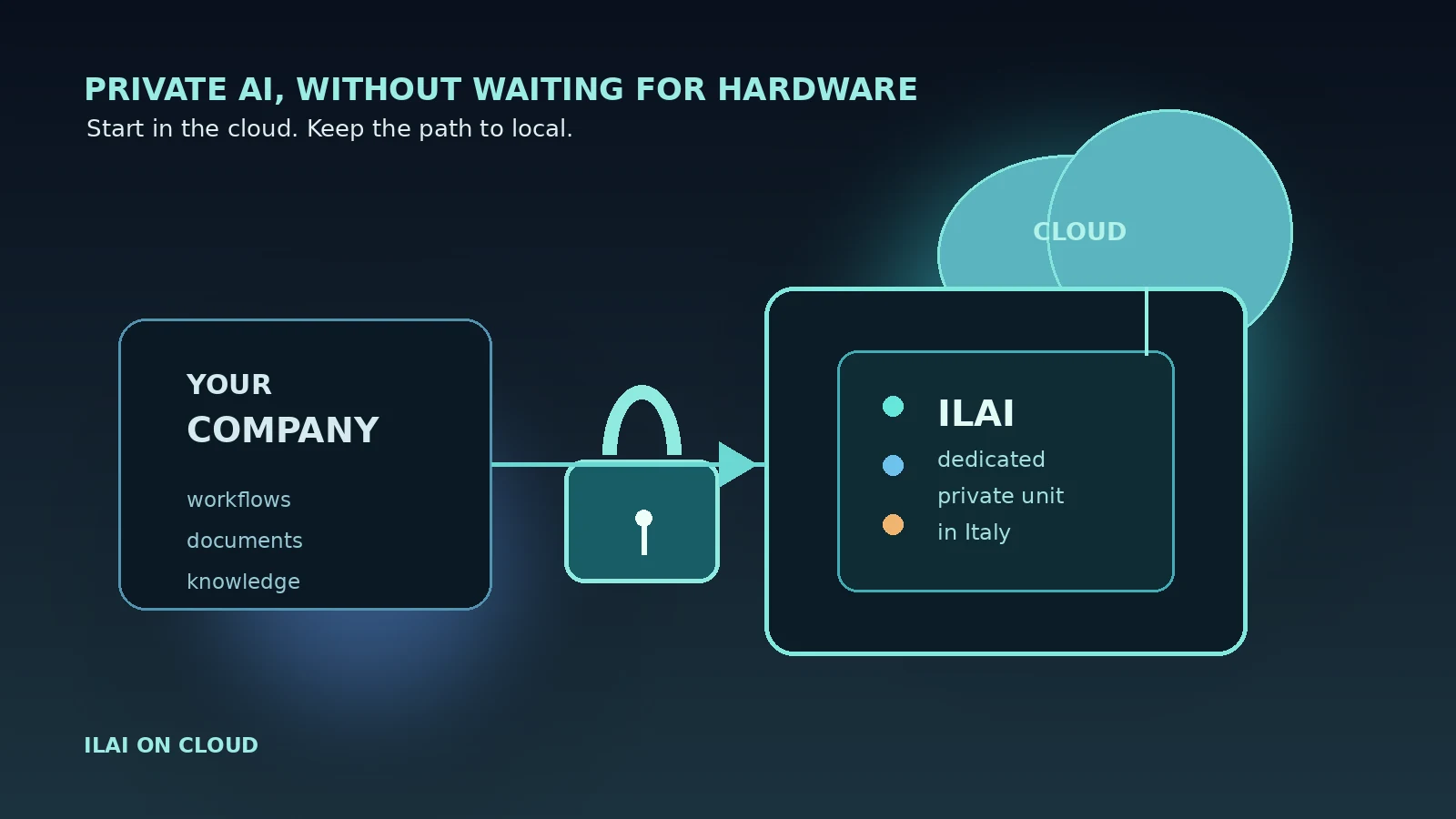
Does my data stay mine? With ILAI on-prem, yes: everything runs on a machine in the company’s office. With ILAI on-Cloud, the data stays on Italian infrastructure, on a dedicated unit. In both cases, it doesn’t go to a server in the United States.
What does the local box do that a subscription can’t? Voice (live), OCR (live), and video generation (on request, as a specialized service), all on the client’s machine — and the data stays the company’s. A cloud subscription doesn’t offer data on-site, at any price.
Want to see how your company’s work would get done, in your systems, with your data? Let’s talk.