How to Choose a Tool to Manage Your Family’s Medical Records
 Guide to choosing the right tool to organise medical records for the whole family: essential criteria, privacy and centralised management.
It’s Sunday evening. Tomorrow morning, your child has a paediatrician appointment, and you need the blood test results from two weeks ago. You’d saved them… somewhere. Perhaps in your email. Or in the cloud. Or in your bag with the other documents. Meanwhile, your mother calls: the cardiologist has asked for last month’s CT scan, but she can’t remember where she filed it after the last visit.
This scenario isn’t rare. It’s the daily reality for those managing the health of an entire family, between young children, elderly parents, and their own personal medical documentation. The fragmentation of medical records isn’t just an organisational inconvenience: it’s a constant source of stress and clinical risk.
Laura’s Case: When Fragmentation Becomes Unsustainable
“I have two school-age children, an elderly mother who lives far away, and I myself follow a chronic therapy. Every month, I manage 5-6 medical appointments. Medical records end up everywhere: some I receive via email from private laboratories, others are printed for me at the hospital, and others are in the Electronic Health Record, but only for those resident in Lombardy. When the paediatrician asks me, ‘Did you bring the tests from three months ago?’, I panic. I’ve tried to organise everything into folders on the computer, but it’s become a mess. I need a system that allows me to keep everything under control, without having to become a professional archivist.”
— Laura, 38 years old, mother of two children and caregiver
Laura’s case represents a reality shared by millions of Italian families: health management isn’t an individual activity, but a complex coordination that requires adequate tools, not improvisation.
The Origin of the Problem: The Inadequacy of Traditional Tools
The fragmentation of family health documentation derives from a set of structural limitations that make traditional approaches inadequate:
Absence of tools designed for families: Public systems, such as the Electronic Health Record, are designed for individual access. A parent cannot centrally manage their children’s medical records. A caregiver cannot coordinate an elderly person’s documentation in their care. Each family member is isolated in their own system.
Multiplication of channels: Each healthcare facility adopts different delivery methods. The private laboratory sends medical records via email. The public hospital sometimes uploads them to the regional Electronic Health Record, or through a dedicated portal, for up to 45 days. The specialist delivers them in paper format. The paediatrician attaches them to a WhatsApp message. Result: documentation scattered across dozens of platforms and in different formats.
Impossibility of controlled delegation: Those caring for elderly parents or coordinating children’s appointments need access to health records, but current systems don’t provide secure, granular delegation mechanisms. The choice is between sharing personal credentials (privacy risk and violation of terms of service) and having no access at all (total inefficiency).
Absence of an overview: Managing four or five people means monitoring vaccinations, periodic check-ups, chronic therapies, and specialist visits. Without a centralised tool, it’s impossible to maintain a complete chronology and promptly identify clinical needs (for example, an expiring vaccine or a check-up to schedule).
These limitations aren’t just organisational: they translate into diagnostic delays, duplicate tests, caregiver stress, and discontinuity of care.
Organise your whole family’s medical records
Try Ippocra
Criteria for Choosing a Family Management Tool
Not all health management tools are designed for family needs. Before adopting a solution, it’s essential to evaluate the specific characteristics that determine practical usability in the family context.
Multi-Profile Management and Centralised Control
An adequate tool must allow a single administrator (parent, caregiver) to manage the medical records of multiple people centrally, maintaining logical separation and privacy:
-
Distinct family profiles: Each family member has their own separate digital archive. The child’s medical records don’t mix with the parent’s. The older adult’s documentation remains distinct from the caregiver’s. This separation isn’t just organisational, but ensures that each sharing with external doctors exposes only the relevant data.
-
Unified dashboard: The parent or caregiver views the health status of the entire family unit in a single interface; this overview transforms health management from reactive (responding to emergencies) to proactive (anticipating needs).
-
Universal acquisition: Regardless of the reception channel (email, CD, WhatsApp, paper), medical records can be acquired and archived in the correct profile with a few clicks or with a single photograph. Our technology automatically recognises the type, date, and clinical content.
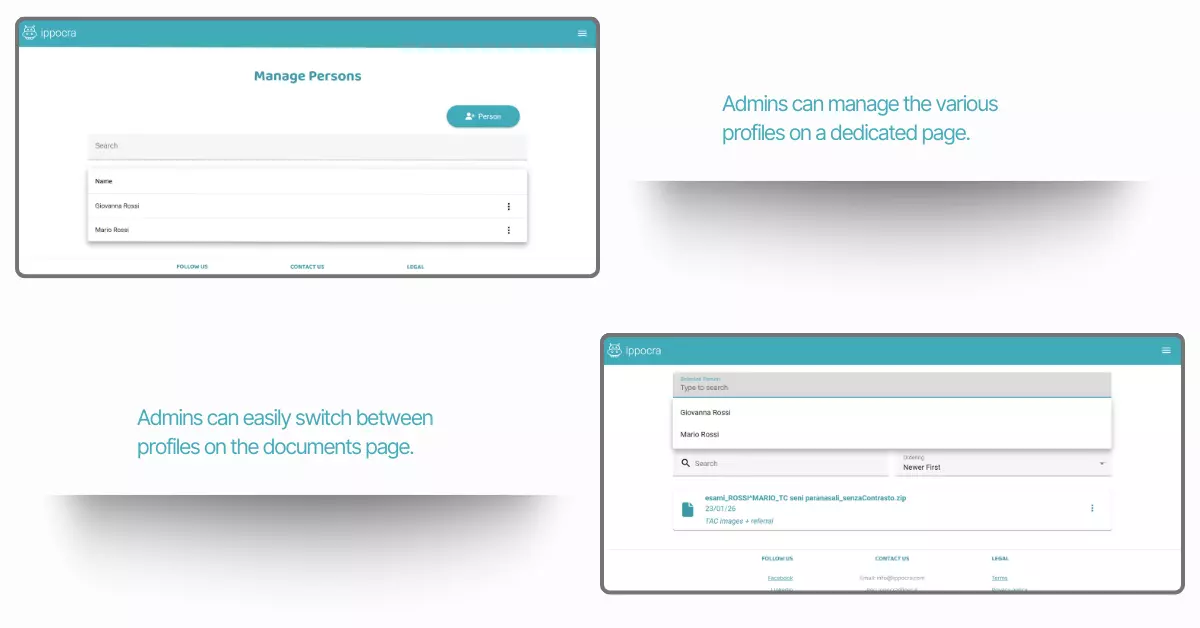 Ippocra’s dashboard with multiple family member profiles
Intelligent Search and Immediate Accessibility
The value of a family archive lies in the ability to instantly retrieve the necessary information, even when it’s requested without notice:
-
Cross-profile search: “All thyroid tests done in the family in the last two years” becomes a query executable in seconds. Helpful in identifying family patterns or preparing genetic consultations.
-
Contextual filters: View only the medical records of a specific member, only those relating to a speciality (cardiology, paediatrics), or only those from a time period. The complexity of the family archive is managed through customised views rather than manual navigation.
-
Mobile access: During an urgent paediatric visit, the parent must be able to access previous tests even when away from home immediately. Mobile accessibility isn’t optional, but an essential requirement for real use.
Selective Sharing and Granular Privacy
Family management amplifies the complexity of privacy: sharing with doctors, maintaining separation between profiles, ensuring traceability:
-
Sharing by profile: When sharing documentation with the paediatrician, only the child’s medical records are exposed, not those of the entire family. This granularity protects the privacy of all members.
-
Traceable temporary links: Each sharing generates a secure link with automatic expiry and complete traceability. The caregiver knows exactly which doctors have access to which data and when they consulted it.
-
Revocation control: If a link has been shared by mistake or the consultation has concluded, access can be revoked immediately from any device. Control always remains in the hands of the parent or caregiver.
The Difference Between Generic Tools and Dedicated Health Tools
Many families attempt to organise medical records using generic tools such as Google Drive, Dropbox, or local folders on the computer. This apparently simple solution hides hidden problems:
Absence of health structuring: A PDF file called “analysis_march.pdf” in a “Documents/Health/Mario” folder doesn’t contain medical metadata. It’s not searchable by test type, not chronologically comparable, and not selectively shareable. It’s just one document among thousands.
Risk of non-compliant sharing: Sharing a Google Drive folder containing medical records exposes the entire set of documents, not just specific ones. Furthermore, generic services don’t guarantee compliance with health regulations on sensitive data privacy.
Manual maintenance: Renaming files, organising folders, creating subfolders for each family member, remembering where everything has been archived: management becomes a part-time job that takes away time and energy.
A dedicated platform like Ippocra eliminates this friction: each medical record is automatically classified, indexed, made searchable and shareable in a granular way. Technology works for the family, not the other way around.
The Conscious Choice: Functionality vs Simplicity
When evaluating a family management tool, it’s about combining two needs:
Easy to use, but feature-rich: Targeted, easy-to-use features are needed: rapid acquisition, automatic organisation, secure sharing, and immediate search.
Underestimating the importance of compliance: “I’ll send them via WhatsApp” is a risky approach for health data. GDPR compliance, end-to-end encryption, privacy-conscious sharing, and keeping data visualisation available only to interested parties aren’t technical details; they’re fundamental guarantees to protect sensitive information.
The optimal choice balances ease of use (intuitive interface, minimal learning) with technical robustness (guaranteed privacy, scalability, reliability).
Conclusion: From Fragmentation to Control
Managing an entire family’s medical records shouldn’t require archival skills or hours of manual work. Technology exists to simplify this complexity, giving back to the parent or caregiver what really matters: the peace of mind that every piece of health information is archived, accessible, and shareable when necessary.
Laura, after adopting Ippocra, has stopped living in pre-visit panic. Now she knows exactly where to find every medical record of her children, can share her mother’s documentation with doctors in a few seconds, and has a complete view of the family’s health status. This control isn’t just organisational: it’s therapeutic.
The question isn’t whether to digitalise family management, but how to do it in a secure, efficient, and sustainable way over time.
Frequently Asked Questions
How many family profiles can I manage with Ippocra?
Ippocra lets you create distinct profiles for each family member you wish to manage: children, a partner, and elderly parents. Each plan has a predefined number of profiles, which can be consulted on our dedicated page. Each profile maintains its own logical separation and privacy, but can be centrally managed by a single parent or caregiver account. This allows both family management and respect for autonomy: an adult child can have direct access to their own profile, whilst the parent maintains visibility for coordination.
How does privacy work between different family profiles?
Each family profile is logically separated and protected. When sharing documentation with a doctor, only the medical records of the specific selected profile are exposed, never those of other family members. The account administrator (parent/caregiver) has complete access to the profiles they manage, but this trust relationship is explicit and controlled. Furthermore, each external sharing is tracked by profile, ensuring full transparency about who has access to which health data.
Can I transfer management of a profile when a child comes of age?
Yes, Ippocra provides transition mechanisms to reflect the natural evolution of family relationships. When a child reaches adulthood or wishes to manage their health documentation independently, the profile can be converted into an independent account, preserving the entire chronology of archived medical records. This ensures clinical continuity without sacrificing autonomy. Alternatively, the young adult can keep the profile managed by the parent and obtain direct access in shared mode.