How to Organise Your Parents’ Health Documents (Without Going Crazy): A Practical Guide
 How to organise your family’s medical documents without going crazy
“I have all my mother’s documents and I’m going mad”: How to organise your family’s health (once and for all)
Do you know that feeling of anxiety that hits you when the doctor asks, “Can you show me the latest 2022 test?” and you know that test is buried somewhere in a WhatsApp chat, a messy drawer, or a computer folder called “Misc”?
If you manage the health of an elderly parent, or even just yours and that of your children, you know exactly what I’m talking about. Document management becomes a burden that triggers stress and anxiety.
Just a few days ago, a new user of ours, whom we’ll call Marco (a fictitious name for privacy reasons), wrote us a sentence that perfectly sums up the mood of thousands of Italian caregivers:
“I have all my mother’s documents: I need to organise them once and for all. I’m going mad.”
Marco wasn’t just looking for “a tool”. He needed peace of mind.
 Translation:
I’ve seen you activated the subscription to Ippocra. How do you find it?
I wanted to write you… I am thrilled!!!
This is the feedback we received: he was thrilled!!!
Here’s how he managed to put ten years of clinical history in order in a single afternoon, and how you can do it too.
Why old habits (WhatsApp and Paper Files) no longer work
Before using Ippocra, Marco did what almost everyone does:
- The physical file: heavy, impossible to carry around, and old sheets fade.
- Photos on the phone: quick, yes, but try to find a specific blood test among 5,000 vacation and cat photos.
- WhatsApp: sending reports via chat is the norm, but it’s the least secure way to handle sensitive data (plus, they could be extracted from WA).
The result? Chaos. And when there’s an emergency, chaos creates panic.
Want to escape the chaos? Try Ippocra for free
The “Zero Stress” approach to digitisation
Marco’s fear was that he’d have to spend whole days scanning. The reality turned out very different. To create an efficient personal digital health folder, you don’t need to be a tech expert.
Here are the three steps that transformed Marco’s (and his mother’s) health management.
1. Snap and forget (Ippocra does the rest)
Instead of using a slow scanner, Marco used his smartphone camera directly in the app. The difference? Ippocra’s technology
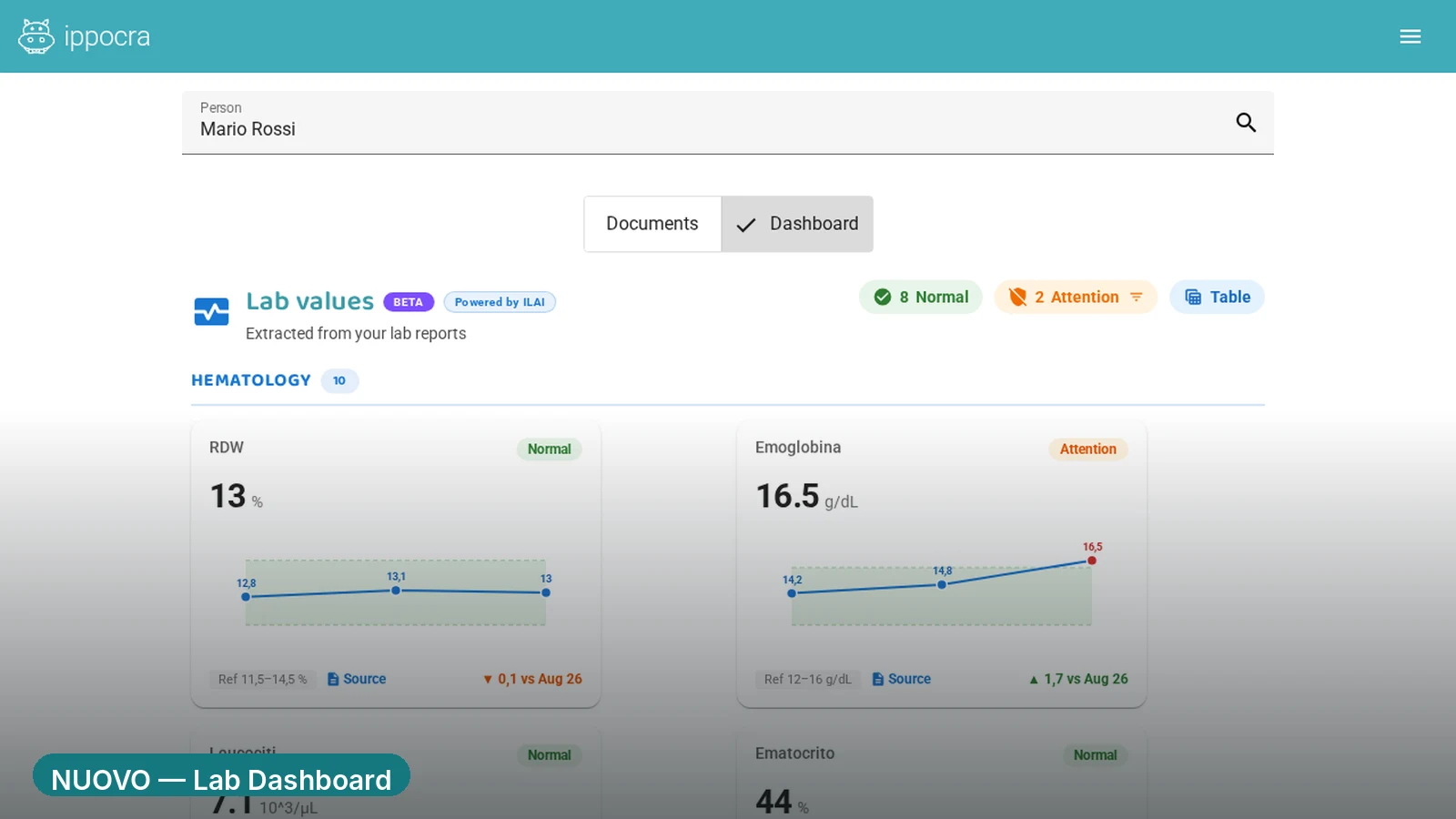
Ippocra doesn’t just save “a photo”. It reads the document, recognises it as a “Blood Count”, reads the date “12 May 2023”, and archives it chronologically.
- Before: Scan → Transfer to PC → Manually rename file (“mother_blood_may.pdf”).
- Now: Snap → Done.
2. “Smart Search” that saves appointments
The real test for Marco came at the next visit. The specialist needed to compare a value with a report from two years earlier. Marco didn’t have to frantically scroll through his phone gallery.
He opened Ippocra, typed “Cardiologist 2022” in the search bar, and the report appeared instantly. Having a medical report archive always in your pocket, indexed and ordered, turns a medical visit from a stressful moment into a productive conversation.
3. Share without losing control
Often children (caregivers) need to send reports to doctors or share them with siblings. Marco stopped scattering sensitive PDFs via email or chat.
Now he generates a secure, temporary link. The doctor clicks, sees the reports in high definition without downloading anything, and the link expires after a short time. The data stays safe, privacy is protected (we’re GDPR‑compliant), and Marco retains total control.
Don’t wait for an emergency to get organised
Marco’s story teaches us one thing: waiting until an emergency to sort documents is a recipe for disaster.
Organising your parents’ (or your own) clinical history isn’t just about tidiness. It’s about safety and timeliness in care.
You don’t have to do everything in one day. Start by uploading the last three reports sitting on your desk. You’ll notice the difference right away.
Take control of your health. Stop “going crazy” and start breathing.
Create your free account in 30 seconds
Frequently Asked Questions about managing reports
What is a medical report and why is it important to keep it?
A medical report is the official document drafted by a specialist doctor, a laboratory analysis, or the result of a CT scan, MRI, or X‑ray, which records the outcome of an exam. Keeping it is essential to allow physicians to monitor the evolution of a condition over time and compare current results with past ones.
What’s the difference between a report and a diagnosis?
While a report is the technical account of a single exam (e.g., an ultrasound or a blood test), a diagnosis is the overall clinical judgement issued by the treating physician who interprets one or more reports to identify a disease.
How can I read reports online easily?
Today many healthcare facilities make results available on their portals. However, they may only be accessible for up to 45 days before they have to be removed. The most practical solution is to use an app for medical reports like Ippocra, which lets you centralise, read, and organise everything in a single protected digital archive.
Is there an app to download the medical reports of the whole family?
Yes, Ippocra is designed precisely for that. You can create separate profiles or folders to manage the health documents of children and elderly parents, overcoming the limits of the Electronic Health Record that often doesn’t allow smooth, integrated family management.