Cloud AI vs local AI: the real cost of a subscription

The seed is what you own: small, quiet, yours. The tree is what grows from it: the skill, the workflows, the patterns you've built over years. On a subscription, the tree isn't yours. On a local agent, it is.
This post doesn’t say “local AI is cheaper” — it isn’t, on paper. It says something else: the difference isn’t the price. It’s who owns what. And to understand what you’re actually signing, you have to read the Terms of Service — not the landing page. As the post that opened this series already put it, the question isn’t “agent or chat”: it’s who owns the capability that does the work.
How a cloud AI subscription actually works
Let’s start with how the product you’re buying is built.
A subscription to ChatGPT or Claude gives you access to a model that runs on the vendor’s infrastructure. The model isn’t yours. The infrastructure isn’t yours. Your prompts, your conversations, your documents — they pass through that infrastructure, get processed there, and stay there under a contract the vendor can update unilaterally.
The part nobody reads before signing is the Terms of Service. They’re long, they’re legal, and they’re written to be ignored. But they contain the economic model of the product, in black and white. Here’s what the public documents of OpenAI and Anthropic say, in full (current as of 27 October 2026, retrieved the day we wrote this post):
The cost is a business decision, not a commitment
The subscription is subsidized. The price you pay doesn’t cover the cost of the tokens you consume — the vendor eats the difference. OpenAI doesn’t publish what a subscription actually costs them to serve. They don’t have to. The API price list tells the story: the same calls you make through a consumer subscription would cost €150–800/month on the API, depending on volume and which model tier you’re on. An enterprise plan doing serious document processing, voice, and multi-model workflows can easily hit thousands of euros in equivalent API cost per month.
The subsidy is a business decision. Business decisions change. OpenAI’s Terms of Use (current as of 27 October 2026) say:
“We may change our pricing from time to time, with 30 days’ notice.”
That’s not a threat. It’s a contractual clause. The day the subsidy stops being worth it, your monthly fee doubles or triples, or they add usage caps that make your workflow impossible, or they quietly swap the model underneath and your outputs get worse. You don’t have a contract that protects the price. You have a clause that says “we may.”
You don’t control the cost. They do. And they can change it whenever.
The rules change without your consent
OpenAI’s Usage Policies are updated regularly. The most recent update added new restrictions on training competing models, “automation of high-stakes actions in sensitive areas without human review” — including financial, legal, medical, employment activities — and model-access intermediary platforms. The list gets longer with every update.
Enforcement isn’t consistent. What works this month may be flagged next month. Your workflow — the thing you built your process around — can become a policy violation overnight.
Anthropic’s Usage Policy (current as of 27 October 2026) is the same mechanism:
“If we suspect that you may have violated our Usage Policy, we may warn you or throttle, limit, suspend, or terminate your access to our products and services.”
“We will update our policy as our technology and the associated risks evolve or as we learn about unanticipated risks.” There’s no appeal process that’s fast. There’s no “we’ll let you keep using it for 6 months while you transition.” The policy changes, and the restriction is live.
You don’t control what the AI is allowed to do. They do. And the rules change without your consent.
They can turn off your service. For any reason.
OpenAI’s Terms of Use (current as of 27 October 2026):
“We reserve the right to suspend or terminate your access to our Services or delete your account if we determine: You breached these Terms or our Usage Policies. We must do so to comply with the law. Your use of our Services could cause risk or harm to OpenAI, our users, or anyone else.”
No notice required. No specific reason beyond “we determined.”
Anthropic’s Consumer Terms (current as of 27 October 2026) add the right to delete your data:
“We may modify, suspend, or discontinue the Services or your access to the Services.” “Upon termination… we may at our option delete any Materials or other data associated with your account.”
And Anthropic’s Commercial Terms (current as of 27 October 2026) for business customers:
“Anthropic may suspend Customer’s access… if Anthropic reasonably believes or determines that… Anthropic’s provision of the Services to Customer is prohibited by applicable law or would result in a material increase in the cost of providing the Services.”
Both vendors reserve the right to turn off your service. Neither needs a specific reason beyond their own determination. Neither requires notice.
This isn’t theoretical. Companies have had accounts suspended mid-project, with months of work and client data locked behind a login screen. The appeal process exists, but it’s slow, and in the meantime, your work stops.
The thing you don’t own: the skill
This is the point most posts don’t name, and the most important one.
When you use a cloud AI subscription to build a workflow — a document review process, a triage system, an agent that does the work inside your systems — you’re building a skill. A skill is: the set of instructions that tells the AI how to do the work, the company’s rules, the tones, the guardrails, the integration with your systems (ERP, CRM, invoicing), the patterns you’ve refined over time.
That skill is an asset. It has value. You built it — or you paid someone to build it. But where does it live?
It lives in the account. In your ChatGPT or Claude profile. On their servers. In their databases. Tied to your login.
When the vendor closes the account — and the Terms let them, as we just saw — the skill dies with it. You can’t export it. You can’t move it to another system. You can’t transfer it. It was a rental, and the rental is over.
With a local agent, the skill is a file. It’s on a disk you own. It’s code, configuration, and logic — things you can copy, version, transfer, and maintain. It’s not tied to an account. It’s not subject to a termination clause. If you decide to change hardware tomorrow, the skill transfers. If you decide to turn the agent off for a month, the skill is still there, intact.
The skill is the most valuable thing you build with AI. On a subscription, it’s not yours. On a local agent, it is.
Your data crosses an ocean — and so does your knowledge
Every prompt you send to a US cloud AI service carries your data with it: client names, prices, margins, supplier terms, internal documents. OpenAI’s ToS say it’s not used to train the model. Fine. But it’s processed on servers you don’t own, in a jurisdiction you don’t control, under laws you didn’t write.
The data crosses an ocean. It sits in a third party’s infrastructure. It’s governed by a ToS that says “we may use Content to provide, maintain, develop, and improve our Services.” The opt-out exists, but it’s buried, and it doesn’t change the fact that the data physically left your building.
Anthropic is more explicit about data ownership — their Commercial Terms state “Customer Content is Customer’s Confidential Information” and “Anthropic may not train models on Customer Content from Services.” That’s reassuring. But the data still sits on their servers, in their jurisdiction, under their ToS. And their Consumer Terms add:
“We may use Materials to provide, maintain, and improve the Services and to develop other products and services, including training our models, unless you opt out of training through your account settings.”
Even with the opt-out, the data physically left your building. The difference between “we won’t train on it” and “it’s on your hardware” is the difference between a promise and a fact.
For a professional practice, this means your client relationships are in a US or Irish server. For a trading company, your pricing and supplier terms are in a third-party data center. For a workshop, your process knowledge — the thing that’s yours, the thing you built over years — is being processed by a third party, on hardware you don’t own, under rules you can’t change.
This isn’t a GDPR fine waiting to happen. It’s a structural exposure. The risk is low if nothing leaks. The exposure is total if something does.
You don’t control where your data goes or what happens to it. They do. And it’s half a world away.
What changes when you own the system
A local agent inverts every point. It’s not a price question — it’s an architecture question.
| Cloud subscription | Local agent | |
|---|---|---|
| The model | Theirs. Runs on their servers. | Yours. Runs on your hardware. |
| The skill | Lives in the account. Dies with the account. | A file on your disk. You own it, version it, transfer it. |
| The cost | Subsidized. Can change with 30 days’ notice. | Fixed. Hardware you own, maintenance you control. |
| The rules | Their Usage Policies, updated unilaterally. | Yours. It’s your machine. |
| Access | They can suspend or terminate it, no notice required. | Can’t be turned off. The hardware is in your office. |
| The data | Crosses an ocean. Third-party jurisdiction. | Stays in your building. |
The difference isn’t “more expensive” or “less expensive.” It’s who owns what. And the answer to that question decides everything else: the long-term cost, operational continuity, skill ownership, and where your data lives.
ILAI: the system you own
ILAI on-prem is a local agent. The skill is built for your process, the integration is done in your systems, and the hardware is a server you buy and own.
- The skill is yours. It’s a file on your disk. You can version it, transfer it, maintain it. It’s not tied to an account.
- The hardware is yours. A GPU server in your office. You buy it. It’s yours.
- The cost doesn’t grow with usage. No per-token billing. No per-page, per-hour, per-user. Voice, OCR, agent — flat.
- The data never leaves the building. No ocean. No third-party jurisdiction.
- Nobody can turn it off. There’s no account to suspend. There’s a server in your office.
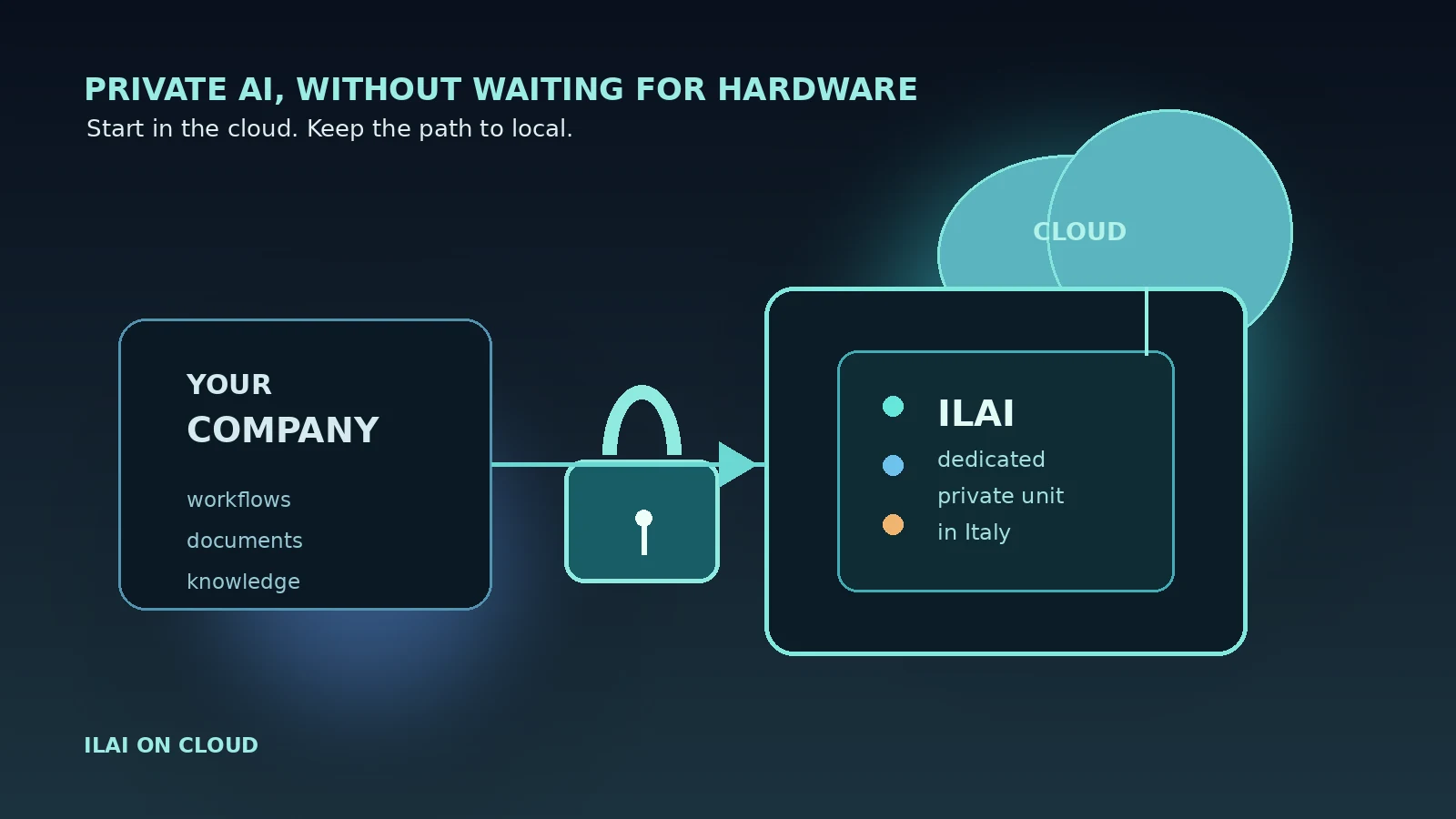
ILAI on-cloud is the path for those who want to start now: the skill is the same, the integration is the same, but the hardware is on Italian infrastructure (Seeweb, Regolo Zero Data Retention certified inference). The data stays in Italy. And when you’re ready to go on-prem, the skill, the integration logic, and the work patterns transfer. The migration is a hardware + deployment step, not a rebuild.
You start in weeks. You move to on-prem when it makes sense for your budget and your risk tolerance. You’re not locked in — you’re on a path.
The honest comparison
| Your situation | The right path |
|---|---|
| You want a chat for personal questions | Cloud subscription. It’s fine for that. It’s not what we sell. |
| You want the work done, in your systems, with your data staying | Local agent. You own the skill, the hardware, and the data. |
| You want to start now and move on-prem later | ILAI on-cloud. Italian infrastructure, zero data retention, path to on-prem. |
| You have an engineering team that builds software | DIY build. You own it, you maintain it. Makes sense if that’s your business. |
The question that matters isn’t “how much does it cost per month.” It’s: who controls the cost, the rules, the access, and the data? With a subscription — OpenAI or Anthropic — the answer is always “the vendor.” With a local agent, the answer is “you.”
Want to understand what this means for your company? Let’s talk.